
Introduction
GS1 UPC barcodes are scanned over 10 billion times daily worldwide, functioning as the single identifier connecting a product from the factory floor to the store shelf. For retail operations, these barcodes aren't optional—they are the operational backbone. When a product moves from receiving and inventory to POS checkout or recall management, the UPC barcode is the access key to every system it encounters.
Understanding GS1 UPC barcode features—its 12-digit structure, quiet zone requirements, X-dimension tolerances, and print quality grades—is essential for consistent scan performance, retail compliance, and supply chain accuracy.
A barcode that fails to scan at checkout doesn't just slow the transaction. It triggers manual overrides, chargebacks, shipment rejections, and inventory traceability breakdowns.
This guide breaks down what retail businesses need to know:
- Structural features of the UPC-A barcode
- Physical print specifications and tolerances
- Registration and validation requirements
- Consequences of non-compliance
- Common misinterpretations that cause barcode failures
Key Takeaways
- A GS1 UPC-A barcode encodes 12 digits: a GS1-issued company prefix, a brand-assigned item reference, and a check digit
- Official GS1-issued GTINs are mandatory for selling through major retailers and marketplaces—third-party barcodes routinely fail registry validation
- X-dimension, quiet zone width, and print quality grade determine whether a barcode scans reliably in retail environments
- Non-compliant barcodes cause POS failures, retailer chargebacks, shipment rejections, and inventory breakdowns
- Each product variant requires its own unique GTIN; reusing barcodes across variants is a costly compliance error
What GS1 UPC Barcodes Represent in Retail Operations
The GS1 UPC-A is the globally dominant retail barcode standard: a 12-digit Global Trade Item Number (GTIN) encoded into a pattern of parallel bars and spaces. It is not a generic barcode format but a registered, globally unique product identifier issued exclusively under the GS1 identification system.
The barcode serves a dual role. It is simultaneously a design specification—fixed structural rules govern how it is constructed—and an operational parameter. It must perform reliably across POS scanners, warehouse readers, and mobile devices under variable lighting, distance, and surface conditions.
The GTIN is the number; the barcode is the machine-readable symbol encoding that number. Retailers' systems do not read the bars—they decode the number and look it up in a linked product database. The barcode is the physical access key to that entire data ecosystem.
How GS1 UPC Barcodes Function Across Retail Operations
Each scan triggers a four-step lookup chain that completes in milliseconds:
- Scanner (laser or imager) reads the bar-space pattern
- Decodes the 12-digit GTIN
- Queries the retailer's POS or ERP database
- Returns product name, price, and inventory record
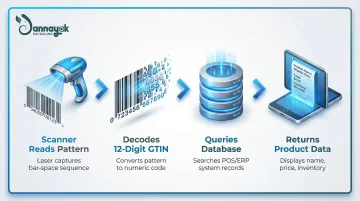
The entire sequence depends on the barcode being structurally correct and physically readable.
Retail and supply chain operations that depend on accurate UPC scanning include:
- POS checkout
- Goods receiving
- Stock adjustment
- Product picking
- Stock transfers
- Cycle counts
- Order lookup
- Product recall management
A single failed scan at any stage creates a data gap that cascades through the entire system, resulting in inventory inaccuracies, stockouts, and operational delays.
Structural Features of the GS1 UPC-A Barcode
The UPC-A barcode is governed by fixed structural rules defined in the GS1 General Specifications. Each of the 12 digits occupies a defined zone, and structural elements like guard bars and parity encoding are built into the symbol to ensure scanner reliability. These are not design choices—they are compliance requirements.
The 12-Digit GTIN and What Each Section Represents
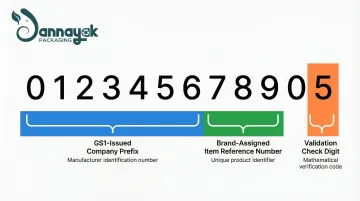
The 12-digit GTIN is divided into three functional segments:
- Company Prefix (first 6–10 digits): Assigned by the national GS1 member organisation (e.g., GS1 India, GS1 US). A shorter prefix allocates more item numbers; a longer prefix allocates fewer.
- Item Reference Number (middle digits): Assigned by the brand owner. Every distinct variant—different size, weight, colour, or packaging level—requires its own unique reference number.
- Check Digit (12th digit): Calculated from the preceding 11 digits using a GS1-defined modulo-10 weighted formula. If the scanner's recalculated check digit does not match the encoded one, it rejects the read outright rather than passing a bad product ID.
Guard Bars, Center Bar, and Bidirectional Scan Design
The UPC-A symbol includes three guard bar structures, each serving a distinct role:
- Left guard bar: Signals the start of the symbol and anchors the scanner's entry point
- Centre guard bar: Separates the two 6-digit halves and confirms the scanner is positioned correctly
- Right guard bar: Signals the end of the symbol and closes the scan boundary
Together, these allow the scanner to locate and orient itself even when a product is swiped at an angle.
Opposite parity encoding is what enables omnidirectional scanning. Left-side and right-side digits are encoded in reversed bar-and-space patterns. This structural asymmetry lets scanners detect and self-correct for reading direction—a UPC-A decodes identically whether scanned left-to-right or right-to-left, which keeps checkout lines moving regardless of how a cashier presents the product.
Physical Specifications That Govern Retail Scan Performance
The structural digit features define what the barcode identifies. The physical specifications—X-dimension, magnification factor, quiet zone width, and print quality grade—define whether it can be reliably read in real-world retail conditions. Failure in any one of these parameters is sufficient to cause scan rejection regardless of whether the GTIN itself is correctly structured.
X-Dimension and Magnification Factor
X-dimension is the width of the narrowest bar or space in the barcode symbol. GS1 specifies a nominal X-dimension of 0.330 mm for UPC-A, with an allowable magnification range of 80%–200% of nominal size.
This translates to:
- Minimum X-dimension (80%): 0.264 mm
- Maximum X-dimension (200%): 0.660 mm
- Minimum barcode height (80%): 18.28 mm
- Maximum barcode height (200%): 45.70 mm
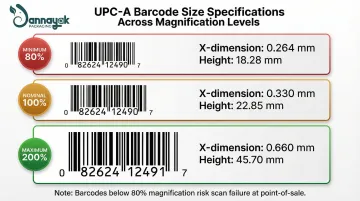
Reducing magnification below 80% produces bars too narrow for laser scanners to resolve at standard POS scanning distances. GS1 Australia notes that the more truncated a barcode is, the less likely it is to scan successfully on the first attempt.
Quiet Zone Requirements
The quiet zone is the blank, unmarked space that must appear on both sides of the barcode symbol. GS1 requires a minimum quiet zone of 9X (nine times the X-dimension) on the left side and 9X on the right side of a UPC-A. This space signals the scanner where the barcode begins and ends.
Insufficient quiet zones cause edge misreads or complete scan rejection. Encroachment of text, artwork, or packaging edges into the quiet zone is among the most frequently cited causes of retail barcode scan failures. This error typically occurs when the barcode is correctly designed in artwork files but then placed too close to design elements during packaging production.
Print Quality and MRQ Grading
ISO/IEC 15416 print quality verification grades retail barcodes on a scale of 4.0 (A) to 0 (F) across parameters including symbol contrast, reflectance, edge determination, decodability, and defects. GS1 recommends a minimum grade of 1.5 (C) for retail use, though many major retailers require 2.5 (B) or higher in their supplier manuals.
Walmart specifically requires a minimum Grade B for print-and-apply labels and Grade C for direct-to-corrugate printing.
The MRQ grade depends on:
- Label substrate (paper, polyester, polypropylene)
- Ink coverage and density
- Printing method (thermal transfer, direct thermal, flexographic, offset)
- Interaction between ink and label surface
A correctly encoded GTIN printed on a non-compliant label material or at incorrect print density will fail quality verification even if every structural parameter is correct. Label material selection and print consistency are therefore as critical as the encoding itself — which is why suppliers like Gannayak Packaging, who specialise in printed barcode labels for retail applications, factor compliance requirements into their label production process.
How GS1 UPC Barcodes Are Registered, Encoded, and Validated
Getting a GS1 UPC barcode into the supply chain involves three sequential steps: registration, encoding, and validation. Each stage plays a distinct role in making the barcode trusted and scannable across retail systems.
The registration process works as follows:
- Brand owners apply to their national GS1 member organization to obtain a Company Prefix
- They then self-assign GTINs within that prefix for each individual product
- Product data is registered in the GS1 Global Registry (Verified by GS1), creating a verifiable public record
- Retailers and marketplace platforms query this registry to confirm a barcode belongs to the company claiming to sell the product
Encoding the GTIN
Once a GTIN is assigned, the brand owner encodes it into a UPC-A barcode symbol using GS1-compliant generation software or a label printing system. The GTIN serves as the numeric identifier — what gets registered and what scanners decode. The barcode symbol is simply the visual representation of that number, printed on the label and subject to GS1's physical specifications for size, contrast, and quiet zones.
Marketplace and Retailer Validation
Platforms such as Amazon, Walmart, and major grocery chains verify product barcodes against the GS1 Global Registry before accepting listings or supplier shipments. Two common validation outcomes to know:
- Barcodes from third-party resellers often carry company prefixes registered to the reseller, not the brand — a mismatch that triggers automatic validation failures
- GS1's Verified by GS1 tool lets any business check whether a barcode is correctly registered before going live with a product listing
Implications of Non-Compliant GS1 UPC Barcodes in Retail
Scan Failure at POS
Barcodes that fall outside GS1 size, quiet zone, or print quality specifications fail to scan at checkout, forcing manual entry. According to GS1 Austria's best practices guide, a failed scan requires either a hand-scanner rescan—adding roughly 10 seconds per transaction—or manual key entry, which adds up to 30 seconds.
Those delays compound fast during peak hours, slowing throughput and frustrating customers at the point where their experience matters most. Beyond the checkout lane, scan failures also carry financial consequences for suppliers.
Retailer Chargebacks and Shipment Rejection
Major retailers enforce barcode compliance through supplier routing guides and barcode verification requirements. Non-compliant barcodes can result in:
- Chargebacks: Macy's imposes a $50 expense offset per receipt plus 50% of merchandise cost for UPC/GTIN/EAN non-compliance
- Shipment holds: Amazon flags shipments as non-compliant when barcodes are missing, unreadable, or incorrectly formatted, triggering chargebacks for manual relabeling
- Shelf removal: Products pulled from retail floors until compliant labels are applied at the supplier's cost

Supply Chain Traceability Failure
When a barcode cannot be read at any point in the supply chain—goods receiving, putaway, picking, or dispatch—the system logs inaccurate inventory records. Those errors trigger stockouts and incorrect purchase orders. In a product recall scenario, the consequences are more serious: without reliable scan data, isolating and withdrawing affected units becomes slow and unreliable.
Common Misinterpretations of GS1 UPC Barcodes in Retail Practice
Treating Any Barcode That Looks Like a UPC as a Valid GS1 Barcode
Many businesses use internally generated or third-party reseller barcodes that appear visually identical to GS1 UPC barcodes but are not registered under the brand's own company prefix. These pass visual inspection and often scan correctly at POS, but fail GS1 Global Registry validation when submitted to major retailers or marketplace platforms.
Assuming One GTIN Covers All Variants of a Product
A single GTIN identifies one specific product configuration. A different size, weight, color, or packaging count is a separate trade item requiring its own unique GTIN. GS1 rules mandate that any change exceeding 20% to a physical dimension or gross weight triggers a new GTIN assignment.
Using one barcode across multiple variants causes:
- Incorrect inventory records at the SKU level
- POS mischarges at checkout
- Compliance rejections from retailers and marketplace platforms
Validating Barcode Compliance from the Design File Rather Than the Printed Label
Barcode artwork may be correctly specified in digital files but get scaled down, overlapped by design elements, or printed at reduced contrast during packaging production. Compliance must be verified by scanning the actual printed label under retail-equivalent conditions — not by reviewing the artwork file.
This is especially relevant with thermal transfer or flexographic printing, where ink spread and substrate interaction can degrade barcode quality enough to cause scan failures in the field.
Frequently Asked Questions
What is the difference between a GS1 barcode and a regular UPC barcode?
A UPC is a specific type of GS1 barcode (the GS1 UPC-A format), not a competing standard. All UPCs are GS1 barcodes, but not all GS1 barcodes are UPCs. Other GS1 formats include EAN-13, GS1-128, and GS1 DataMatrix.
How many digits does a GS1 UPC-A barcode have, and what does each part represent?
UPC-A encodes 12 digits: a GS1-issued company prefix (identifying the brand owner), a brand-assigned item reference (identifying the specific product variant), and a single check digit (calculated mathematically to validate scan accuracy).
What size should a GS1 UPC-A barcode be for retail packaging?
GS1's allowable magnification range is 80%–200% of nominal size, with the nominal X-dimension of 0.330 mm. Going below 80% risks scan failure. The final printed barcode must also include minimum quiet zones of 9X on each side.
Do I need a GS1 UPC barcode to sell on Amazon or in major retail stores?
Yes. Major retailers and marketplace platforms (Amazon India, Flipkart, major retail chains like Reliance Retail) require GTINs issued through official GS1 membership and verified against the GS1 Global Registry. Products with unregistered or reseller-sourced barcodes are typically rejected at listing or shipment.
What causes a UPC barcode to fail scanning at a retail point of sale?
Main failure causes include insufficient quiet zone, undersized bars (below 80% magnification), poor print quality (low contrast or damaged bars), and incorrect check digit. Meeting each corresponding GS1 specification directly eliminates these failure points.
Can I use the same UPC barcode for different product sizes or colors?
No. GS1 rules require a unique GTIN for each distinct product variant. Differences in size, color, weight, or pack count each constitute a separate trade item requiring its own barcode. Reusing a GTIN across variants violates GS1 standards and causes inventory and compliance errors.