Introduction
Shoppers spend just 1.6 to 3.2 seconds scanning a product label before deciding whether to buy. In that narrow window, your label must communicate value, ensure legal compliance, and build brand trust—all at once.
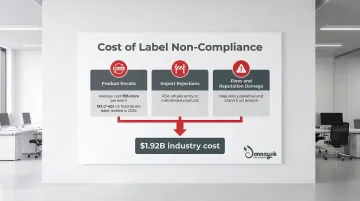
Yet many businesses treat labels as an afterthought. The result? Compliance violations, consumer confusion, and lost sales. In 2024, label errors triggered 45.5% of all US food recalls, costing the industry an estimated $1.92 billion. The vast majority—83.85%—stemmed from undeclared allergens.
Getting labeling right isn't just a regulatory checkbox—it's a business-critical decision. This guide covers label types, mandatory requirements, regulatory frameworks across India and the US, and practical design strategies to keep you compliant and competitive.
TLDR:
- Labels serve dual roles: legal compliance and brand differentiation
- Four main types: informational, branding/descriptive, regulatory/safety, and environmental
- Mandatory elements include product name, ingredients, net quantity, manufacturer details, and batch/expiry dates
- Label errors cost businesses millions in recalls and fines
- Smart design choices—visual hierarchy, material selection, and sustainability—drive both shelf performance and compliance
What Is Product Labeling and Why Does It Matter?
Product labeling is the practice of displaying structured information on a product or its packaging. It communicates identity, contents, instructions, and brand elements to consumers while meeting legal obligations.
The Dual Role of Labels
Labels perform two critical functions:
Functional: They inform buyers about ingredients, usage instructions, warnings, allergens, and quantities. This transparency enables safe, informed purchase decisions.
Commercial: They differentiate your product on crowded shelves and reinforce brand identity through logos, color schemes, and design consistency.
Three Key Stakeholders
Product labels serve three distinct groups:
- Consumers rely on labels for ingredient details, safety warnings, and usage guidance to make informed choices
- Businesses use labels to build brand recognition, establish trust, and stay legally protected
- Regulatory bodies reference labels to verify compliance and uphold public health standards
Globally, 39% of consumers rank environmental impact as extremely or very important in purchasing decisions. But vague "eco" claims trigger skepticism. Verified certifications, by contrast, command premium pricing — particularly among Gen Z and Millennial shoppers.
Types of Product Labels
Informational Labels
Informational labels carry factual product data: ingredients, nutritional values, usage instructions, storage guidelines, and allergen warnings. They are mandatory for food, pharmaceuticals, and chemicals.
Why accuracy matters: Missing or inaccurate information triggers recalls and fines. In 2024, 192 out of 422 US food recalls were label-related. Specific examples include:
- Mellace Family Brands recalled chocolate nonpareils for undeclared milk allergen
- Kinjin Food Pvt Ltd faced a nationwide US recall for asafoetida powder containing undeclared wheat traces
Branding and Descriptive Labels
Beyond mandatory information, labels are also powerful marketing tools. Two types drive product differentiation on the shelf:
- Branding labels feature your logo, brand name, color palette, and tagline to build instant recognition. Consistent branding across product lines strengthens consumer loyalty.
- Descriptive labels highlight specific product claims—"new formula," "50% more," "dermatologist tested." Common in FMCG, cosmetics, and electronics, these differentiate products within competitive categories.
Regulatory and Safety Labels
Regulatory and environmental labels are non-negotiable for companies operating across regulated industries.
Regulatory labels are mandated by law and include safety certifications (BIS, CE, ISI), hazard warnings for chemicals and electronics, age-grading for toys, and country-of-origin declarations. Skipping or misapplying these can result in product bans, import rejections, or significant penalties.
Environmental labels signal sustainability credentials through eco-certifications like recyclable, compostable, or FSC-certified markings. Verified certifications combat greenwashing and build consumer trust:
- BPI certifies compostable products meeting ASTM D6400/D6868 standards
- FSC verifies responsibly sourced forest materials
Security and Holographic Labels
Security labels—holographic, tamper-evident, and void labels—prevent counterfeiting, authenticate products, and protect brand integrity. They're essential in automotive parts, electronics, pharmaceuticals, and luxury goods.
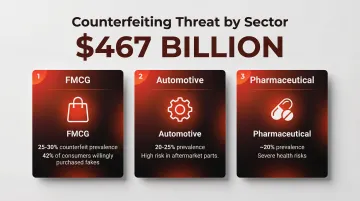
The counterfeiting threat: Global trade in counterfeit goods reached $467 billion in 2021. In India, the economy loses approximately ₹1 trillion annually, with FMCG seeing 25-30% perceived counterfeit prevalence.
| Sector | Counterfeit Prevalence | Key Impact |
|---|---|---|
| FMCG | 25-30% | 42% of consumers willingly purchased fakes |
| Automotive | 20-25% | High risk in aftermarket parts |
| Pharma | ~20% | Severe health risks; India identified as origin for counterfeit drugs seized in EU |
Advanced authentication: Proprietary holographic labels, such as those developed using Gannayak Packaging's Cheko technology (created with IIT Kanpur), provide multi-layer authentication. Cheko incorporates a unique 3D tactile pattern, distinct QR code, and unique number—creating a "fingerprint" for each product that's extremely difficult to replicate.
Key Elements Every Product Label Must Include
Every compliant product label shares a common set of mandatory elements — regardless of industry or product category. Missing even one can trigger regulatory action or delay product clearance.
Product Name and Brand Identity
The product name must clearly describe what the item is. The brand name or logo should be prominently placed. Labels that omit or obscure the product name are among the most frequently cited labelling violations during regulatory inspections.
Ingredients or Contents List
List all components in descending order of proportion. This requirement applies across food, cosmetic, and chemical categories under Indian regulations including FSSAI labelling norms. Accurate allergen callouts are critical for food and personal care products.
Net Quantity or Weight
Declare net quantity by weight, volume, or count in a standardised location — typically the principal display panel. In India, net quantity declarations are governed by the Legal Metrology (Packaged Commodities) Rules, 2011, which specify both the required units and placement on the label.
Manufacturer/Importer Details
Include the name and complete address of the manufacturer, packer, or importer. The Legal Metrology Rules also require consumer care contact details on Indian product labels.
Usage, Storage, and Safety Instructions
Products with specific usage conditions — medicines, chemicals, electronics — must carry clear instructions and safety warnings. Include hazard pictograms for dangerous substances.
Batch/Lot Number, Manufacturing and Expiry Dates
These traceability elements are critical for quality control and product recalls. They are legally mandatory for food, pharma, and several other product categories.
Product Labeling Compliance Requirements
Overview of Regulatory Landscape
Labeling laws vary by country and product category.
United States:
- FDA: Governs food, drugs, cosmetics, and medical devices
- CPSC: Oversees consumer product safety
- FTC: Regulates advertising claims
India:
- FSSAI: Enforces food safety and labeling standards
- Legal Metrology Act 2009: Governs weights, measures, and MRP declarations
- BIS: Sets standards for electronics and industrial goods
Industry-Specific Requirements
Food Labels:
- Nutritional information, allergen declarations, FSSAI license number (India)
- Governed by FSSAI Regulation 4(3)(a)
Pharmaceuticals:
- Drug schedules, dosage, manufacturer licensing
- Batch numbers and expiry dates for traceability
Electronics:
- ISI/BIS markings, electrical safety warnings
Apparel:
- Fiber content, care instructions
Skipping these requirements isn't just an oversight — it carries real financial and legal consequences.
Consequences of Non-Compliance
- Product recalls: Average cost of ₹83 crore per event
- Import rejections: FDA can refuse entry to products deemed "misbranded"
- Regulatory fines and brand reputation damage
In 2024, label-related issues triggered 192 out of 422 food recall events in the US, costing the industry nearly $2 billion.
Keeping Labels Updated
Non-compliance often traces back to labels that simply weren't updated in time. Formula or ingredient changes must be reflected on labels promptly — and regulators set firm deadlines. As of 2026, FSSAI standardizes labeling amendments to take effect annually on July 1, with a 365-day transition period to allow businesses to adapt.
Best practice: Build a label review process into product development cycles. Keep documentation of compliance approvals.
Best Practices for Designing Effective Product Labels
Prioritize Readability and Hierarchy
Key information—product name, key claim, net quantity—should be immediately legible at shelf distance.
Font size minimums:
- US (FDA Nutrition Facts): Calories minimum 16 point; numeric calories 22 point
- India (Legal Metrology): Net quantity numeral height depends on package size (1mm for packs up to 200g/ml; 4mm for packs >500g/ml)
Design tips:
- Use high-contrast fonts
- Avoid decorative fonts for legal copy
- Keep layouts uncluttered — crowded labels hurt both compliance legibility and shelf appeal
Match Label Material and Adhesive to Product Environment
Labels on frozen goods, chemical containers, or outdoor equipment need specific properties:
- Waterproof: For moisture-exposed products
- UV-resistant: For outdoor applications
- Temperature-stable: For frozen or heated goods
Using the wrong material leads to label failure and compliance issues. Gannayak Packaging's white film labels use waterproof adhesive backing engineered for harsh environments — holding print quality through moisture, chemicals, and abrasion.
Incorporate Sustainability Thoughtfully
Consumer and regulatory pressure to use eco-friendly label materials is rising. Options include:
- Recycled paper
- Biodegradable substrates
- Solvent-free inks
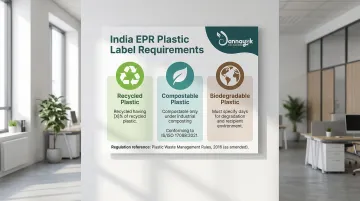
India EPR requirements: Under the Plastic Waste Management (Amendment) Rules, producers must label:
- Recycled plastic: "Recycled having [percentage] of recycled plastic"
- Compostable plastic: "Compostable only under industrial composting" (conforming to IS/ISO 17088:2021)
- Biodegradable plastic: Specify days for degradation and recipient environment
Gannayak Packaging supports EPR compliance directly through its plastic recycling programme, helping businesses source sustainable label materials that meet these requirements.
Common Product Labeling Mistakes to Avoid
Incorrect or Missing Mandatory Information
Omitting mandatory fields—net quantity, manufacturer address, batch number, expiry date—is the most common compliance error. Before finalising artwork, run a pre-print compliance checklist tailored to your product category and target market.
Overcrowding the Label
Trying to fit too much text and imagery makes labels hard to read and buries legally required information. A clear visual hierarchy solves this — assign priority to compliance fields first, then brand elements around them.
Failing to Account for Multiple Markets
Businesses selling across regions (India and export markets) must ensure labels meet the standards of every market:
- Language requirements
- Unit systems (metric vs. imperial)
- Agency-specific certifications
Artwork designed for one market will typically fail compliance checks in another — build multi-market requirements into the design brief from the start.
Frequently Asked Questions
What is product labeling?
Product labeling is the practice of displaying printed information on a product or its packaging to communicate contents, usage, brand identity, and legal details to consumers and regulators.
What are the 4 types of product labels?
The four commonly referenced types are informational labels, branding and descriptive labels, regulatory and safety labels, and environmental labels. Each serves a distinct purpose — from communicating ingredients and usage to displaying certifications and eco-ratings.
What information should be on a product label?
Core mandatory elements include product name, ingredients or contents, net quantity, manufacturer details, usage and safety instructions, and batch/expiry information. Exact requirements vary by product category and country.
What is a manufacturer label?
A manufacturer label is affixed by the producer and includes key product identity details: brand name, manufacturer's name and address, country of origin, batch number, and certifications. This distinguishes it from retailer or importer labels, which are added later in the supply chain.
What are the labeling requirements for products sold in India?
In India, labeling requirements are governed by multiple bodies depending on product type. FSSAI regulates food labels (requiring nutritional info, allergens, and FSSAI license number), while the Legal Metrology Act mandates net quantity, MRP, and manufacturer details across most packaged goods. BIS certification marks apply to certain electronics and industrial products. For products exported to the US, FDA requirements apply separately.
How to get a label code?
A barcode for retail products is obtained by registering with GS1 India, the national affiliate of the global GS1 standards body. GS1 India assigns a unique company prefix used to generate GTINs — the barcodes required for retail scanning and supply chain tracking.