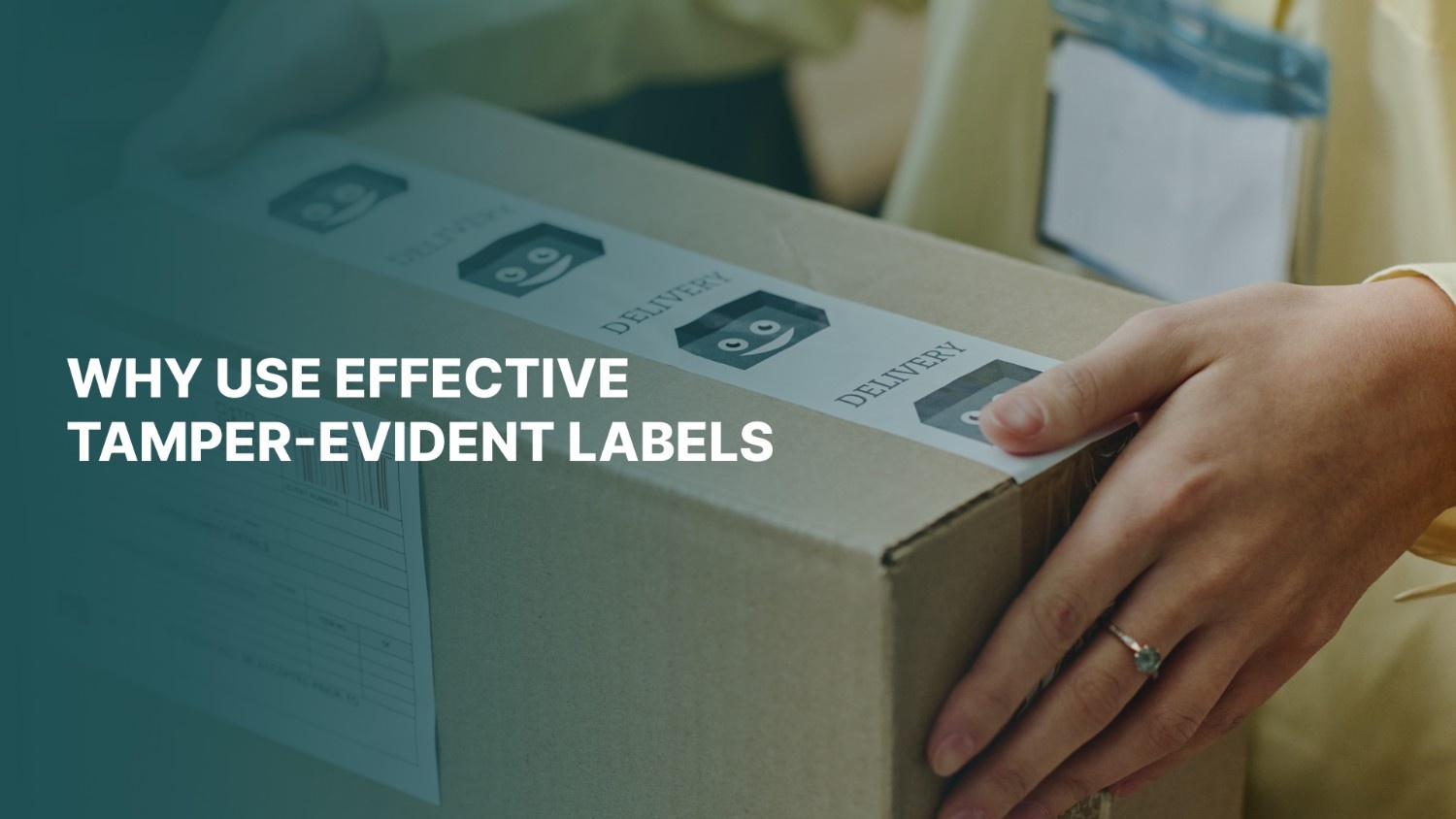

During audits or product investigations, one of the first checks often involves verifying whether equipment housings or packaging seals have been disturbed. Without a reliable tamper indicator, proving unauthorized access becomes difficult and time-consuming.
Security stickers are designed to solve this challenge by revealing immediate and irreversible signs of tampering, supporting traceability and compliance across industrial operations.
This blog covers how do security stickers work, detailing their operating mechanisms, core components, available types, real-world applications, and the technical considerations businesses should assess before implementation.
Key Takeaways
Security stickers function by creating irreversible visual evidence of tampering through engineered material, adhesive, and print-layer interactions.
Different security sticker types, such as VOID, destructible, holographic, and residue-based labels, use distinct mechanisms to indicate unauthorized access.
Tamper-evident stickers do not prevent access but provide immediate detection, making them essential for accountability and compliance.
Performance depends heavily on technical factors including surface compatibility, environmental exposure, and integration with variable identification data.
When combined with barcodes or serial tracking, security stickers become part of a broader traceability and asset-protection system.
What Are Security Stickers?
Security stickers, also known as tamper-evident labels, are specialized labels designed to reveal visible signs when unauthorized access or interference occurs. Unlike standard identification or branding labels, their primary function is to indicate whether a product, package, or enclosure has been opened, altered, or compromised after application.
These stickers work by undergoing an irreversible change when tampered with. This change may appear as a visible message, material breakage, residue transfer, or surface damage, making it immediately clear that interference has taken place.
Security stickers are commonly used to:
Detect unauthorized opening of packages or containers
Protect products against tampering and counterfeiting
Support traceability and accountability during transit and storage
Provide visual confirmation during audits or inspections
It is important to distinguish security stickers from tamper-resistant technologies. Tamper-resistant solutions are designed to delay or discourage access, while tamper-evident security stickers do not prevent tampering but clearly indicate that tampering has occurred, enabling quick detection and response.
This visible evidence is what makes security stickers an essential control mechanism across industrial and regulated environments.
How Do Security Stickers Work?

Security stickers work through engineered interactions between materials, adhesives, and print layers that create irreversible visual evidence when tampering occurs.
Instead of relying on electronics or sensors, they use physical and chemical principles that make clean removal difficult or impossible.
The most common tamper-indication mechanisms include:
1. Adhesive and material interaction: Security stickers are manufactured with specialized adhesives that bond aggressively to the application surface. When removal is attempted, the adhesive separates unevenly from the label face material, leaving behind residue or a visible message that cannot be reapplied cleanly.
2. Destructible materials: Some security stickers use fragile or low-tensile films that fracture into small pieces when peeled. This material breakup prevents reuse and clearly indicates unauthorized removal.
3. Visible “VOID” messages: VOID security stickers contain hidden patterns embedded within the adhesive or print layers. When lifted, a predefined message such as “VOID” or “OPENED” appears on the surface or label, providing immediate visual confirmation of tampering.
4. Security cuts and perforations: Engineered cuts or micro-perforations are incorporated into the label structure. These controlled break points force the sticker to tear during removal, eliminating the possibility of intact repositioning.
By combining these mechanisms, security stickers ensure that any attempt to access a sealed product, package, or enclosure leaves clear, irreversible evidence of interference.
Types of Security Stickers and Their Working Mechanisms
Security stickers are available in several formats, each designed to indicate tampering through a specific physical response.
The selection depends on the level of security required, surface type, and operating environment.
Void security stickers: These stickers reveal a hidden message such as “VOID” or “OPENED” when removal is attempted. The message may remain on the application surface, the label itself, or both, making reapplication impossible without visible evidence.
Destructible security stickers: Manufactured from fragile films, destructible stickers break into small fragments when peeled. This fragmentation prevents clean removal and clearly indicates unauthorized access.
Holographic or intricately printed security stickers: These stickers combine tamper-evident construction with complex visual elements such as holograms, microtext, or fine-line printing. The intricate design makes replication difficult while also revealing distortion or damage when tampering occurs.
Residue or etch-effect security labels: These labels leave behind a permanent adhesive residue or surface mark when removed. The residue acts as a clear indicator that the seal has been broken, even if the sticker itself is taken off.
Each type relies on a different tamper-response mechanism, allowing businesses to select security stickers based on threat level, visibility requirements, and application conditions.
Why Security Stickers Are Not “Tamper Proof”
Security stickers are often described as tamper proof, but technically they are tamper-evident, not tamper-resistant. Understanding this distinction is important for setting correct expectations and selecting the right level of protection.
Tamper-evident solutions are designed to reveal unauthorized access. They do not prevent tampering; instead, they provide immediate visual confirmation that interference has occurred. Once disturbed, the label shows irreversible signs such as residue, breakage, or hidden messages.
Tamper-resistant solutions, by contrast, are intended to delay or discourage access through physical barriers, locks, or reinforced enclosures. These methods make tampering more difficult but may not always provide visible proof once access occurs.
Security stickers focus on detection rather than prevention. Their value lies in accountability, traceability, and rapid identification of compromise.
For businesses, this distinction ensures security stickers are used as part of a broader protection strategy rather than as a standalone physical barrier.
Industrial Use Cases of Security Stickers in 2026

Security stickers are widely used across industries where unauthorized access, product alteration, or component replacement can create safety, financial, or compliance risks.
Their role is to provide clear, visible evidence of tampering at critical control points.
Manufacturing: Used on machinery enclosures, control panels, and spare parts to indicate unauthorized access during production or maintenance.
Pharmaceuticals and healthcare: Applied to product packaging, cartons, and containers to support patient safety, traceability, and regulatory compliance.
Electronics and electrical equipment: Used on devices, PCBs, and housings to protect against component swapping, warranty misuse, and counterfeit replacement.
Logistics and transportation: Applied to cartons, pallets, and shipping containers to detect tampering during transit and storage.
Warranty seals: Used to indicate whether products have been opened after sale, helping validate warranty claims and prevent misuse.
Asset tracking and security: Applied to equipment, IT assets, and tools to monitor unauthorized access and support inspection and audit processes.
These use cases highlight how security stickers function as a simple but effective layer of control across industrial operations.
Selection Considerations for Security Stickers in 2026
The effectiveness of security stickers depends not only on their design but on how well technical specifications align with real operating conditions.
Understanding these factors helps businesses select security solutions that perform reliably while supporting broader traceability and asset-protection systems.
Technical Factors That Determine Performance
Security stickers rely on multiple components working together. Key factors include:
Material choice: Polyester and vinyl films offer durability for long-term use, while destructible films are preferred where immediate tamper visibility is required.
Adhesive strength and surface compatibility: Adhesives must match the application surface, such as metal, plastic, painted, or powder-coated finishes, to prevent premature lifting or incomplete tamper indication.
Print technology and hidden messaging: Specialized printing enables VOID messages, microtext, or layered graphics that become visible only after tampering.
Environmental exposure: Heat, humidity, chemicals, and ultraviolet light can affect both adhesive performance and print clarity if materials are not selected correctly.
Integration with barcodes and serial codes: Variable data printing allows each security sticker to carry unique identification for tracking and verification.
Choosing the Right Security Stickers for Business Needs
Selecting the appropriate security sticker requires evaluating operational risk rather than choosing a generic format. Businesses typically assess:
Required security level based on tamper risk and product value
Surface type and expected adhesion performance
Environmental conditions during storage, transit, and use
Bulk supply requirements to maintain consistency across production batches
Testing and quality assurance, including adhesion testing and tamper-response validation
This evaluation ensures that the selected sticker performs consistently at scale and across repeat orders.
Supporting Traceability and Asset Protection
When combined with identification technologies, security stickers become part of a wider control framework:
Barcode and QR code integration enables verification at multiple checkpoints.
Asset lifecycle tracking links physical seals to digital records for maintenance, warranty, or ownership history.
Audit evidence is strengthened through visible tamper history supported by traceable identification data.
Together, these elements allow security stickers to function not only as tamper indicators, but as active components within modern traceability and asset-protection systems.
How Can Gannayak Packaging Meet Your Security Sticker Needs

Gannayak Packaging provides security labeling solutions designed to support tamper detection, product integrity, and traceability requirements across industrial applications.
Its portfolio of high-security labels includes tamper-evident formats such as VOID labels, destructible labels, holographic security labels, and customized security constructions that reveal clear visual evidence when interference occurs.
These security stickers are developed with application-specific material and adhesive combinations, allowing compatibility with common surfaces such as plastic, metal, glass, and coated substrates.
Options for variable data, sequential numbering, barcodes, and QR codes support product authentication and audit traceability.
Beyond security stickers, Gannayak Packaging offers supporting services that strengthen overall labeling performance:
Barcode labels produced using durable materials suitable for integration with security seals and asset tracking systems.
Thermal transfer ribbons in wax, wax-resin, and resin grades to ensure long-term print legibility on security and identification labels.
Custom label manufacturing with controlled specifications to maintain consistency across bulk production cycles.
Export-ready supply capability supporting regulated and cross-border packaging requirements.
Together, these capabilities enable businesses to implement reliable security sticker programs supported by consistent materials, traceable identification, and scalable manufacturing.
Conclusion
Security stickers are most effective when selected based on application risk, surface conditions, and operating environment rather than appearance alone. The right combination of material, adhesive, and tamper-indication mechanism directly impacts detection reliability, traceability, and long-term performance.
Consistency across bulk orders is equally important, ensuring uniform tamper response and dependable protection throughout the supply chain.
Gannayak Packaging supports these requirements through high-security labels, including tamper-evident, VOID, destructible, and holographic security stickers, along with barcode integration and compatible printing solutions designed for industrial use.
Speak with Gannayak Packaging to discuss your security sticker requirements.
Frequently Asked Questions (FAQs)
1. Can security stickers be removed and reapplied without damage?
No. Security stickers are engineered to show irreversible evidence when removal is attempted. Once lifted, they cannot be reapplied without visible tamper marks.
2. Do security stickers work on all surfaces?
Security sticker performance depends on surface energy, texture, and cleanliness. Smooth plastics, metals, and coated surfaces typically deliver the most reliable tamper response when correct adhesives are used.
3. Can security stickers include unique identification for each unit?
Yes. Security stickers can be printed with sequential numbering, variable data, barcodes, or QR codes, allowing individual product-level verification and traceability.
4. How are security stickers tested before bulk deployment?
Performance testing typically includes adhesion testing, tamper-response validation, environmental exposure checks, and surface compatibility trials to ensure consistent behavior in real-world conditions.
5. Why is supplier capability important for security sticker programs?
Security stickers must perform consistently across thousands of units. Suppliers such as Gannayak Packaging, with controlled manufacturing and material expertise, help ensure uniform tamper indication, repeatable quality, and dependable bulk supply.