Introduction
The packaging industry faces a constant challenge: finding materials that deliver strength, flexibility, and cost efficiency together. Manufacturers need packaging that protects products through demanding logistics without inflating material costs or environmental impact. Linear Low-Density Polyethylene (LLDPE) has become the practical solution to that challenge.
LLDPE's unique molecular structure gives it superior tensile strength and puncture resistance compared to traditional polyethylene films, while remaining flexible enough to conform to any product shape. This allows manufacturers to use thinner films that perform better, cutting material costs by up to 25% in some applications.
The global flexible packaging market is projected to reach USD 440.88 billion by 2033 — a figure that reflects just how central materials like LLDPE have become across food, retail, e-commerce, industrial, and healthcare sectors.
This guide covers what LLDPE is, its standout properties, where it's used across industries, its key benefits, how it compares to LDPE, and its role in sustainable packaging.
TLDR:
- LLDPE delivers 2x the tensile strength of LDPE, enabling thinner, stronger films
- Downgauging with LLDPE reduces material use by up to 25% without sacrificing protection
- E-commerce flexible packaging demand is growing at 9.2% annually, driving LLDPE adoption
- LLDPE is recyclable, FDA-approved for food contact, and supports EPR compliance
- Choose LLDPE when strength and stretch matter; LDPE for clarity and processability
What Is LLDPE?
Linear Low-Density Polyethylene (LLDPE) is a semi-crystalline thermoplastic polymer produced by copolymerizing ethylene with alpha-olefin comonomers—typically butene, hexene, or octene. It belongs to the broader polyethylene family but has a distinct linear molecular structure with short, uniform branches rather than the long, entangled branches found in LDPE.
Molecular Structure
- CAS Registry Number: 26221-73-8 (ethylene-octene copolymer)
- Linear backbone with controlled short-chain branching
- Butene comonomers offer cost efficiency; hexene and octene grades deliver higher mechanical performance
Production Methods
LLDPE is manufactured using gas-phase or solution-phase polymerization—processes that run at lower temperatures and pressures than the high-pressure method required for LDPE. For packaging applications, film extrusion is the dominant processing route, which is why LLDPE is the backbone of flexible packaging films worldwide.
Where LLDPE Sits in the Polyethylene Spectrum
That processing versatility connects directly to how LLDPE fits within the polyethylene family. It occupies the middle ground between LDPE and HDPE, combining flexibility with meaningful tensile strength.
| Grade | Comonomer | Best For |
|---|---|---|
| Standard | Butene | Commodity films, cost-sensitive applications |
| Performance | Hexene | Stretch wrap, industrial liners |
| Premium | Octene | Heavy-duty bags, demanding packaging needs |
Key Properties of LLDPE That Make It Ideal for Packaging
High Tensile Strength and Puncture Resistance
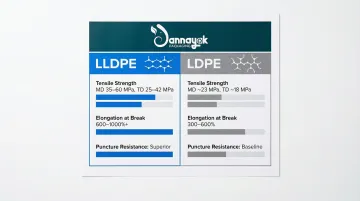
LLDPE's linear chain structure delivers measurably higher tensile strength compared to LDPE. Typical LLDPE films achieve tensile strengths of 35-60 MPa (machine direction) versus approximately 23 MPa for LDPE—nearly double the strength. This allows manufacturers to use thinner films without sacrificing durability.
| Property | LLDPE | LDPE |
|---|---|---|
| Tensile strength (MD) | 35–60 MPa | ~23 MPa |
| Tensile strength (TD) | 25–42 MPa | ~18 MPa |
| Elongation at break | 600–1000%+ | 300–600% |
| Puncture resistance | Superior | Baseline |
Flexibility and Elongation
LLDPE can elongate significantly under stress without breaking — stretching 600% to over 1000% before failure. This exceptional stretch capability enables "downgauging," meaning manufacturers can use thinner films while maintaining strength. This reduces material consumption and cost per unit.
Chemical and Environmental Resistance
Beyond mechanical strength, LLDPE demonstrates excellent resistance to acids, solvents, oils, and bases — making it well-suited for packaging in chemical and industrial environments.
Its Environmental Stress Cracking Resistance (ESCR) far outperforms LDPE. In testing, hexene-branched LLDPE survived over 1000 hours while LDPE failed after just 63.5 hours.
Why this matters:
- Protects products in harsh storage and transit conditions
- Suitable for chemical, food, and outdoor applications
- UV resistance extends outdoor service life
- No degradation from prolonged product contact
Moisture Barrier and Clarity
LLDPE provides effective moisture barrier properties, essential for food and pharmaceutical packaging. While specific MVTR (Moisture Vapor Transmission Rate) values depend on film thickness and density, LLDPE films offer high clarity and transparency that supports brand visibility and product presentation on retail shelves.
Processability and Versatility in Manufacturing
LLDPE is more viscous in extrusion than LDPE and requires specific processing conditions, but it remains compatible with blow molding, film extrusion, and injection molding. Manufacturers commonly blend LLDPE with LDPE — typically 10–50% LDPE — to improve melt strength and bubble stability during blown film extrusion. This preserves LLDPE's superior mechanical properties while easing processing.
LLDPE Packaging Applications Across Industries
Food and Consumer Goods Packaging
LLDPE's moisture barrier, flexibility, and food-safe profile make it the preferred choice in food packaging:
- Stretch wrap and cling film for pallet wrapping and fresh food protection
- Liquid sachets and pouches for shampoo, sauces, and edible oils
- Stand-up pouches with excellent puncture resistance
- Multi-layer food packaging films combining LLDPE with other barrier materials
LLDPE is FDA-approved for direct food contact under 21 CFR 177.1520(c), contains no BPA, and does not leach harmful chemicals under normal storage conditions. Recent innovations have enabled FDA approval for up to 100% post-consumer recycled LLDPE in food contact applications.
Retail, E-commerce, and Logistics
The e-commerce flexible packaging market is projected to grow from USD 35.2 billion in 2025 to USD 84.8 billion by 2035, at a CAGR of 9.2%. India's booming e-commerce sector is a key driver of this growth, with demand for durable, lightweight packaging rising rapidly. LLDPE's puncture resistance and ability to conform tightly around irregular shapes make it a logistics staple:
- Shopping bags for retail point-of-sale
- Courier and mailer bags for shipped goods
- Pallet stretch wrap for warehousing and distribution
- Protective overwrap for e-commerce shipments
Gannayak Packaging supports e-commerce and retail customers — including Amazon and Paytm — with barcode labels and printed labels that integrate with LLDPE-based courier packaging, enabling seamless tracking and branding across the supply chain.
Industrial and Agricultural Applications
LLDPE's chemical resistance and durability serve demanding industrial and agricultural applications:
- Industrial liners for bulk containers and FIBCs (Flexible Intermediate Bulk Containers)
- Geomembranes and pond liners meeting GRI-GM17 standards for flexibility and stress crack resistance
- Agricultural mulch films and silage wrap—mulch film was the largest segment of the agricultural films market in 2023
- Tank liners for chemical transport and storage
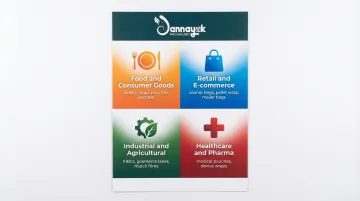
Healthcare and Pharmaceutical Packaging
LLDPE's non-reactive, non-toxic profile makes it suitable for medical applications:
- Medical pouches for sterile instruments and supplies
- Packaging liners for pharmaceutical products
- Protective wraps for medical devices
Studies on LLDPE pharmaceutical packaging show that simulated solar radiation does not induce changes in mechanical properties, and no harmful extracts are detectable under extended product contact conditions.
Automotive and Electronics Packaging
LLDPE serves protective applications in automotive and electronics sectors:
- Protective films for auto parts during assembly and shipping
- Cable jacketing for electrical wire protection
- Anti-static wrap for electronics components
Gannayak Packaging works with automotive and electronics customers — including Maruti Suzuki, Hero, JCB, Havells, and Marathon Electric — supplying barcode and security labels used for component identification, traceability, and compliance across manufacturing and distribution workflows.
Benefits of Using LLDPE Packaging
Cost Efficiency Through Material Reduction
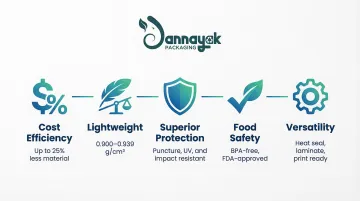
LLDPE's superior strength allows for significant downgauging—using thinner films that perform as well or better than thicker alternatives. Advanced LLDPE grades enable up to 25% downgauging in applications like collation shrink films. This directly reduces raw material usage and lowers per-unit packaging costs without compromising package integrity.
Lightweight Advantage in Logistics
LLDPE's density range of 0.900–0.939 g/cm³ keeps packaging weight low, which cuts shipping costs and reduces fuel consumption in transport. This is particularly valuable for high-volume e-commerce and retail shipments where every gram of packaging weight affects freight costs.
Superior Protection with Design Flexibility
LLDPE combines puncture resistance, impact strength, UV resistance, and flexibility into a single practical material—protecting goods in harsh storage and transit conditions while conforming to virtually any product shape. One film type handles what would otherwise require two or three specialised materials.
Food Safety and Non-Toxicity
LLDPE contains no BPA and is considered non-toxic with no off-gassing in normal use. Key safety properties include:
- Safe for direct food and skin contact
- Does not leach harmful chemicals during prolonged product contact
- Compliant with food-grade and pharmaceutical packaging requirements
Versatility Across Sealing and Printing Processes
LLDPE films support heat sealing (essential for food pouches and sachets), lamination, and surface printing. This compatibility with modern packaging lines and branding requirements makes LLDPE films retail-ready and suitable for high-speed automated packaging operations.
For businesses that want to combine this printability with sustainability goals, Gannayak Packaging supplies recycled LLDPE bags and rolls with custom branding options—so logos and designs go directly onto packaging that also meets EPR compliance requirements.
LLDPE vs. LDPE: Choosing the Right Material for Your Packaging
Structural Difference and What It Means in Practice
LDPE has longer, more entangled branch chains leading to lower tensile strength and less elongation before failure. LLDPE's short, uniform branches give it better tensile strength (35–60 MPa vs. 23 MPa), superior puncture resistance, and greater stretch capability (600–1000%+ vs. 300–600%).
In practice, LLDPE suits high-performance flexible films where strength and stretch are non-negotiable. LDPE works well for simpler wrapping applications where flexibility and optical clarity matter more than maximum mechanical performance.
Processing and Cost Trade-offs
LDPE is generally easier to process due to lower melt viscosity and may have a slight cost advantage in certain commodity applications. LLDPE delivers better mechanical performance per unit of material, enabling downgauging that often results in lower cost per unit despite comparable resin prices.
Blending both materials (LDPE/LLDPE) is common industry practice to balance these trade-offs—typically 10–50% LDPE is added to LLDPE to improve processability while keeping superior mechanical properties.
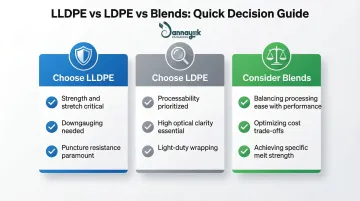
Use the table below to match your application to the right material choice.
Quick Decision Guide
| Choose LLDPE When | Choose LDPE When | Consider Blends For |
|---|---|---|
| Strength + stretch are critical | Processability matters more than peak strength | Balancing ease of processing with mechanical performance |
| Downgauging to reduce material use | High optical clarity is essential | Optimising cost and performance trade-offs |
| Puncture resistance is paramount | Light-duty wrapping (bread bags, shrink films) | Achieving specific melt strength and bubble stability |
LLDPE Packaging and Sustainability
Recyclability of LLDPE
LLDPE is technically recyclable and falls under Resin Identification Code #4 (the same category as LDPE). Recycled LLDPE can be reprocessed into products like trash can liners, compost bins, shipping envelopes, floor tiles, agricultural films, and composite lumber.
Recycling pathways:
- Over 18,000 store drop-off locations in the US accept clean, dry LLDPE bags and wraps
- Curbside recycling generally excludes flexible films — they jam sorting equipment at Material Recovery Facilities
- In Europe, recycled LDPE/LLDPE covered 15% of flexible film consumption in 2020
India's recycling challenges:
India's recycling rate for flexible films sits at roughly 5%, compared to 90% for PET. Infrastructure gaps — particularly around multilayer packaging collection and material recovery facilities — remain the primary barrier.
India's Plastic Waste Management Rules (2016, amended 2022) are pushing change. They mandate Extended Producer Responsibility (EPR) for flexible plastic packaging under Category II, creating direct regulatory pressure on brands and suppliers to close this gap.
Downgauging as a Sustainability Lever
Using thinner LLDPE films to deliver equal or better protection than thicker alternative materials means less plastic per package. This reduction in material use directly lowers a brand's plastic footprint and aligns with EPR compliance goals. Downgauging can cut material use by up to 25% — a measurable gain for any brand working toward plastic reduction targets.
Gannayak Packaging's EPR and Sustainable Packaging Approach
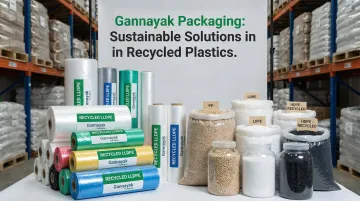
Gannayak Packaging entered plastic recycling in 2024 specifically to support EPR compliance — both for its own operations and for packaging buyers navigating India's Plastic Waste Management Rules. The product range built around this includes:
- Recycled LLDPE polythene bags and rolls from post-consumer materials
- Recycled plastic granules across PP, LDPE, and HDPE grades
- Tear-resistant, lightweight options that maintain performance without virgin plastic
For brands that need to demonstrate recycled content use or meet Category II EPR mandates, sourcing from a supplier with documented recycling operations simplifies the compliance process considerably.
Frequently Asked Questions
Is LLDPE safe for food packaging?
Yes, LLDPE is non-toxic, BPA-free, and approved for direct food contact applications under FSSAI guidelines for food-grade plastics in India. It does not leach harmful chemicals under normal storage conditions, making it suitable for food, beverage, and pharmaceutical packaging.
What is the difference between LLDPE and LDPE in packaging?
LLDPE has a linear structure with short branches giving it higher tensile strength (35-60 MPa vs. 23 MPa) and superior puncture resistance, while LDPE has longer branches making it softer and easier to process but less durable. Choose LLDPE where stretch, load retention, and durability matter most.
Is LLDPE recyclable?
Yes, LLDPE (flexible film) is recyclable through EPR-registered collection systems under India's Plastic Waste Management Rules. It can be reprocessed into trash bags, agricultural films, and other non-packaging products.
What are the main uses of LLDPE film in packaging?
The most common LLDPE packaging film applications include stretch wrap for pallets, food pouches and sachets, shopping and courier bags for retail and e-commerce, industrial liners for bulk containers, and agricultural films for mulching and silage.
Which industries use LLDPE packaging the most?
Food and beverage, retail and e-commerce, industrial/logistics, agriculture, and healthcare are the top industries relying on LLDPE packaging for its flexibility, strength, and cost efficiency. The e-commerce sector is driving particularly strong growth at 9.2% annually.
Can LLDPE packaging help meet EPR compliance requirements?
Yes, LLDPE's recyclability combined with downgauging to reduce plastic volume supports EPR compliance strategies under India's Plastic Waste Management Rules. Brands should source from EPR-registered suppliers offering recycled content options and documented plastic credit trails for responsible end-of-life management.
Looking for sustainable LLDPE packaging solutions? Gannayak Packaging offers recycled LLDPE polythene bags and rolls with customizable branding options, supporting your sustainability goals while meeting BIS quality and EPR compliance requirements. Contact us at +91 9810724403 to discuss your packaging needs and EPR compliance requirements.